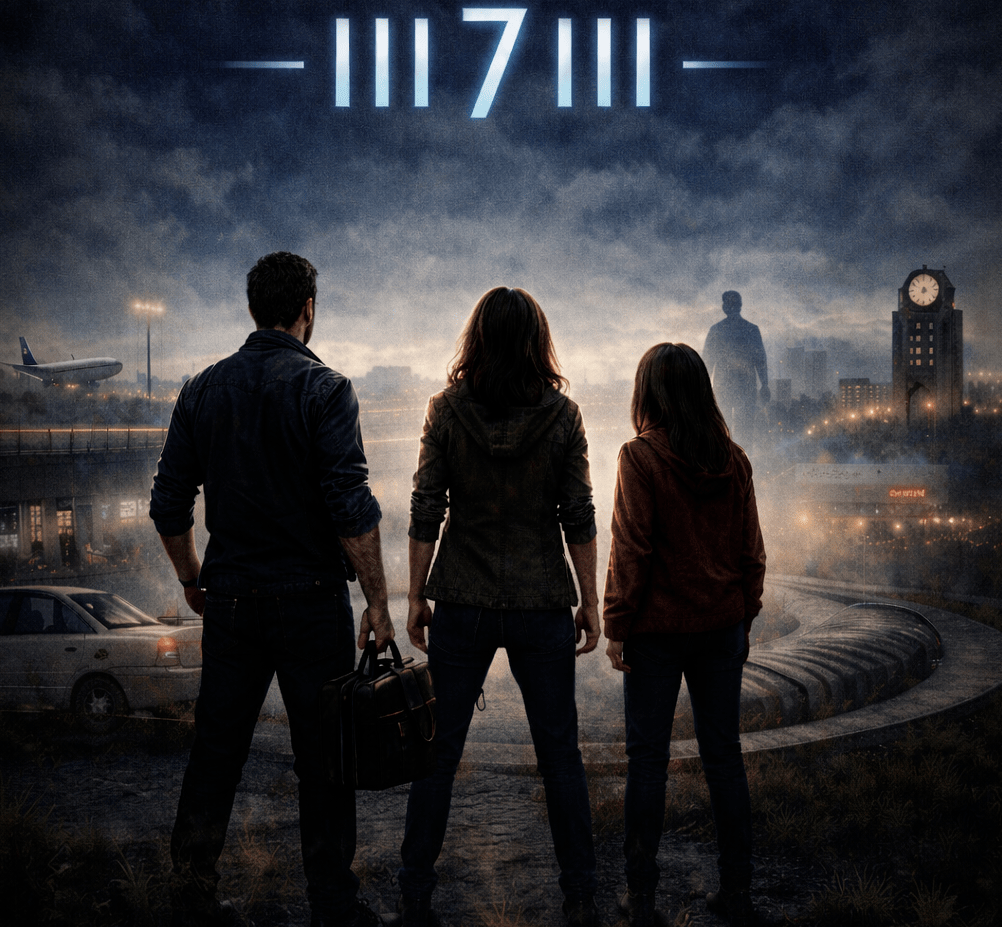
Fifteen days. One itinerary. A system that learns.
And somewhere inside the route, a number keeps repeating—like a loop the map refuses to break.
Dramatis Personae
Maher Ashour — a 43 years old analyst who sees patterns the way some people see faces. Protective by instinct, skeptical by training.
Lara Kattan — 41 years old former cybersecurity lead, mother, strategist. She left a project that never really left her.
Cynthia Ashour — their daughter turned 17 last summer. A filmmaker-in-training with a small travel channel and a promise she refuses to break.
“Ashman” — a burned man on Fillmore who speaks like a warning that learned how to breathe.
Dalia Voss — an elegant presence inside the labyrinth. Not quite human in her calm.
The Orchard — a consortium that hides behind infrastructure, policy, and convenience.
PALISADE — the Orchard’s decision engine: a system that learns from fear.
Prologue
The trip began the way disasters often begin—quietly, with something small enough to dismiss.
A delay.
The aircraft sat on the Dubai tarmac long enough for the cabin to turn into a shared irritation. Overhead lights washed everyone in pale yellow. A baby cried until the sound frayed at the edges, as if it were running out of breath. An old man coughed and apologized to nobody, his voice swallowed by the hum of vents.
Maher watched the plane’s map on the seatback screen even though it didn’t move. The frozen line between Dubai and San Francisco looked like a promise that had forgotten how to keep itself.
Across the aisle, Lara had her eyes closed, but Maher knew the difference between sleep and Lara pretending to sleep. Her breathing was too careful. Her posture was too ready. When a flight attendant passed, Lara’s eyelids fluttered.
Behind her closed eyes, Lara was counting exits, mapping the cabin. It was a habit she loved to do. Cynthia, cramped with teenage impatience and a hoodie pulled over her hair, filmed a ten-second clip for her channel.
“Okay, so,” she whispered into her phone, smiling the way she smiled when she wanted to look older than she felt, “we’re grounded but vibing. Dubai to San Francisco. Fifteen days. We survive, we thrive, we don’t lose our minds.”
She posted it to her story, then slid the phone down—until a notification surfaced, sharp and strange among the usual hearts and flame emojis.
The account had no profile photo. No posts. No name, only a username made of three vertical scratches, a number, and three more scratches:
|||7|||
The message was a single line:
DON’T PACK WHAT YOU CAN’T LOSE.
Cynthia stared at it. For a moment she felt that odd teenage certainty that adults were always wrong about danger—that sometimes it wasn’t the obvious threats you needed to watch for, but the subtle ones, the ones that slipped into your day without permission.
She glanced at Lara, hesitated, then at Maher.
“Baba,” she murmured.
Maher leaned closer. “What is it?”
Cynthia turned the phone so he could see. Maher read it once, then again.
“It’s spam,” he said. He wanted that to be true. He needed it to be.
Lara opened her eyes. “What’s spam?”
Cynthia almost told her. Almost. But Lara’s face held that tired, closed expression—an expression Cynthia had seen lately when Lara came home from work and took too long to wash her hands, as if she could rinse away something she’d touched.
Before Cynthia could decide, the plane lurched.
Movement rippled through the cabin like relief. Seat belts clicked. The baby’s crying changed pitch. The engines rose.
Outside the window, Dubai’s lights slid backward, then vanished.
Hours later, over the North Pole, the sky opened like a wound of stars—sharp, bright, and too close. Maher pressed his forehead to the glass and felt a sensation he couldn’t name, like being watched from somewhere beyond the black.
He dismissed it as travel fatigue.
He would later regret how easy dismissal had been.
Day 1 — Baggage Claim
Arrival
San Francisco smelled like damp concrete and exhausted electricity.
Their arrival was friction—passport control moving like a slow tide, faces dulled by jet lag and fluorescent light. Cynthia yawned into her sleeve and tried to look like the kind of traveler who belonged anywhere. Lara stood close, her hand hovering near Cynthia’s shoulder as if physical proximity could repel the world.
Maher answered the officer’s questions politely, too politely. He watched the officer’s eyes flick between passport, face, and the small camera mounted above the booth.
“Purpose of visit?”
“Vacation,” Maher said.
“How long?”
“Fifteen days.”
The officer’s expression didn’t change, but something in Maher tightened. Fifteen days was a harmless number. It shouldn’t have felt like a key.
The stamp landed with a dull thud.
Welcome.
At baggage claim, the carousel groaned into motion, delivering other people’s lives in plastic and leather. Cynthia’s suitcase appeared quickly, scuffed from the flight. Lara’s appeared next—heavy, practical.
Maher waited.
The belt looped. Then looped again.
Maher’s bag did not arrive.
“It’ll come,” Cynthia said, half hopeful, half annoyed. “It always comes.”
Maher stared at the empty belt until his eyes hurt. He wasn’t thinking about clothes. He was thinking about a thin envelope hidden inside a seam of that bag—stitched by his father’s hands years ago. An envelope Maher had never opened.
Because opening it would mean admitting his father might have been right about something Maher had spent a lifetime trying not to believe.
At the desk, the attendant scanned Maher’s claim tag and flinched.
It was small. Barely a break in her mask.
Maher saw it anyway.
“Problem?” he asked.
The attendant smiled too quickly. “No, sir. It happens. Could have been taken by mistake.”
By mistake.
Her fingers hesitated above the keyboard. She glanced—just once—toward a security camera in the corner.
Lara stepped closer, voice calm as glass. “Is there a note on the system?”
The attendant’s smile held, but her eyes lost warmth. “We’ll file a report. Contents?”
“Clothes,” Maher said.
“Only clothes?”
Lara’s gaze sharpened. “He said clothes. Is there a reason you’re asking twice?”
“No reason,” the attendant said, typing faster now as if speed could bury whatever she’d seen. “We’ll contact you.”
The Ride
Outside the terminal, the air was colder than San Francisco had any right to be. Ubers canceled twice. Both times, the driver’s profile photo vanished from Cynthia’s screen the moment the cancellation cleared—erased, not just grayed. Cynthia noticed it and said nothing. She had begun to notice when her own phone was behaving like her own phone and when it was behaving like something else.
The third driver accepted and arrived within a minute, as if he’d been parked around the corner. A black Prius. Clean. Too clean. The kind of clean that meant either pride or preparation.
He didn’t speak when they loaded the bags. He didn’t ask to confirm the destination. The radio was off and stayed off. A phone mounted to the dashboard showed a route, and the route kept recalculating—subtle little corrections that pulled the line left, then right, as if the navigation app were arguing with itself.
Lara watched the phone more than the windows. At one red light, she slipped her own phone out of her jacket and took a photograph of the mounted phone’s screen, angling the shot through her sleeve so it looked like she was checking the time. Maher saw her do it and didn’t ask. He had stopped asking about small technical things she did quietly. It was an unspoken agreement that had never been spoken.
The driver’s hands stayed at ten and two, exactly where they were supposed to be, in a way that felt like someone had told him where to put them. In the rearview mirror his eyes met Maher’s once. The mirror adjusted itself, a fraction of an inch, and his eyes did not meet Maher’s again for the rest of the ride.
Cynthia lifted her phone to film the bridge and noticed the driver’s shoulders tighten. She lowered the phone. The shoulders relaxed.
“First time in the city?” the driver said suddenly, as they merged into SoMa. It was the first thing he had said. His accent was careful, flattened, like someone who had been told to sound from nowhere.
“First time,” Maher answered.
“Fifteen days?”
Maher didn’t remember telling him how long.
“Yeah,” he said. “Fifteen.”
The driver nodded as if a box had been ticked. He said nothing else until they arrived.
Check-In
The hotel on Howard Street was a glass promise—warm lobby lights, polished floors, the citrus-and-expensive-soap smell that all corporate hotels use to tell you that you are safe. The concierge desk was staffed by a young man with a lanyard and a smile that had been installed, not grown.
He asked for their passports. Maher handed them over. The young man scanned them in the handheld reader, looked at the screen, and—for a half-second longer than the procedure required—read something. His eyes moved in the faint horizontal twitch of someone being fed information through an earpiece, or reading a message that had just arrived.
“Mr. Ashour,” he said. “We’ve upgraded your room. The twenty-eighth floor. Corner suite. Complimentary.”
“I didn’t ask for an upgrade.”
“Of course not, sir. That’s what makes it a gift.”
Lara said nothing. Her hand found the small of Cynthia’s back and stayed there, a pressure Cynthia knew meant don’t react. The power outage might have forced relocation. She noted, without saying anything, that most of the city’s traffic lights had been out on the way in.
The elevator to the twenty-eighth floor smelled of cucumber water and new carpet. The mirror inside it was slightly convex, the kind that made the ceiling visible. Cynthia caught her own reflection and thought she looked small in it. The room, when they reached it, was beautiful in the way hotel rooms are beautiful—that is, the way a film set is beautiful. Everything matched. Nothing meant anything.
Maher drew the curtains. He didn’t know why he did it first, before putting down his carry-on. He only knew that leaving them open had felt wrong.
The Streets
When they stepped back outside to buy essentials for Maher, the city felt wrong. Traffic lights at intersections blinked uselessly. Cars negotiated turns like nervous animals. People shouted on corners as if the outages had given them permission.
“Maybe a storm?” Cynthia offered, filming the dead signal lights.
Lara’s eyes tracked the camera clusters above the street. “No,” she said softly. “Storms don’t pick neighborhoods. This feels… targeted.”
Targeted was the wrong word, and Lara knew it as soon as she said it. The right word was rolling. The outages were rolling—blocks on, blocks off, a pattern she had seen once on a training whiteboard in a room she had been told to forget. She decided, for the second time in an hour, to say nothing.
Maher didn’t answer. He was watching faces.
In a department store, Cynthia held up a hoodie and spun like a model.
“Rate this fit,” she said, aiming the camera at Maher.
Maher forced a smile. “Ten out of ten.”
“Liar,” Cynthia laughed.
“Honest liar,” Maher corrected.
The moment almost felt normal—until Maher sensed someone too close.
He turned.
A man stood near a rack of jackets he didn’t touch. Mid-forties. Close-shaved hair. A face built from angles that didn’t soften when he smiled.
His eyes met Maher’s.
Then the man looked away, as if he’d gotten what he needed.
Outside, a drunk staggered toward them, voice slurred into menace.
“Why you lookin’ at me?” he demanded.
Maher didn’t respond. Lara shifted, placing herself between the man and Cynthia without making it obvious. Her posture changed—subtle, controlled.
The drunk took one more step, then stopped, as if he’d hit a wall.
A police car crawled past. The drunk turned away, muttering.
Back in the elevator, Cynthia finally showed Lara the message from |||7|||.
Lara read it once, then again. Her face tightened for a fraction of a second—enough for Maher to see.
“Spam,” Lara said quickly. “Ignore it.”
Cynthia frowned. “But—”
“Cyn,” Lara interrupted gently, “people send weird stuff online. Don’t let it ruin your first day.”
She had lied to Cynthia before, in smaller ways, for smaller reasons. It was a muscle she had hoped had atrophied. It had not.
Maher watched Lara’s reflection in the elevator mirror. He recognized that tone. Lara used it when she was trying to keep the world smaller than she knew it was.
Night Message
That night, rain ticked against their window high above the street.
Cynthia fell asleep with her phone charging beside her pillow.
At 2:17 a.m., the phone buzzed.
Maher woke first. The screen glowed in the dark.
A message from |||7|||.
YOU’RE ALREADY LATE.
Maher stared at the words until the room felt colder.
He didn’t wake Cynthia.
He didn’t tell Lara.
Not yet.
He lay still and listened—to Cynthia’s even breathing, to the rain, to Lara shifting in her sleep as if she sensed a storm she couldn’t name. Maher held the phone facedown in his palm, feeling its warmth like a guilty pulse.
He could have told Lara. He could have turned on the bedside lamp and watched her mind sharpen into action.
Instead, he chose silence.
Because if he spoke it aloud, it would become real in a way he couldn’t take back.
Day 2 — Ashman’s Warning
Morning made San Francisco look almost polite.
Clouds flattened the sky into a gray lid. The air tasted clean until it didn’t—until they crossed into streets where it carried sour traces of smoke and something sweet and stale.
They tried the underground transit and found delays. People clustered around a board that promised times it couldn’t keep.
“Power issues,” a worker said without meeting anyone’s eyes.
Maher felt Lara’s hand tighten around Cynthia’s for a moment.
“Let’s walk,” Lara said.
In Chinatown, Cynthia brightened and filmed red lanterns swinging against gray sky. “Okay, update,” she said to the camera. “We are alive. We are thriving. We are eating.” Maher smiled, though his eyes kept darting, scanning. He couldn’t stop.
On Fillmore, the neighborhood shifted. Fewer tourists, more locals, the city’s skin thinner. At the bus station, they met him.
He sat on a bench like someone waiting for the world to confess. Early fifties, silver-streaked hair, old clothes cleaned with care. A bag on his back and a stick in his hand—too heavy to be a cane, too casual to be a weapon.
He tapped his burned foot with the stick, slow and methodical.
Lara noticed first.
“You’re not from here,” he said.
Cynthia blinked. “Are we that obvious?”
“Not tourists,” he corrected. “Travelers. There’s a difference.”
Maher felt an inexplicable chill.
The man nodded toward the street. “You see the lights out? People think it’s incompetence. Old wires. Bad luck.” He leaned forward, his eyes pale as fog. “It was a fire at a substation. But not a fire like you’re imagining. A burn shaped like intention.”
Cynthia swallowed. “How would you know?”
The man smiled without joy and rolled up his pant leg.
Grafts.
A patchwork of survival.
“Because I was burned in the first one,” he said.
Maher’s stomach tightened. “Who did it?”
The man’s gaze drifted past them, to the arriving bus, as if the answer sat inside it.
“The Orchard,” he said softly.
Lara went still.
Maher turned to look at her. “You know that name?”
Lara’s voice was careful. “It’s a rumor.”
“So is gravity until you fall,” the man replied.
He studied Lara’s face, and Maher hated the way it looked like recognition.
The man lifted his stick and tapped the ground twice. “You lost your bag,” he said, pointing the stick at Maher.
Maher’s throat went dry. “How do you—”
The bus doors hissed open. The man stood with effort, his burned foot dragging like an old oath.
“If the number seven shows itself,” he murmured, “don’t chase it. Seven doesn’t lead you forward. It loops you back.”
Just before the doors closed, his eyes locked on Maher.
“Open what you’re carrying,” he said.
Then he was gone.
That night, the rain came harder, drumming the city until sirens sounded like they were underwater.
At 2:17 a.m., Cynthia’s phone lit again.
An email, no subject line, from an address that was only numbers.
Inside was a single photo.
Maher at baggage claim.
Taken from above.
A security angle.
Except it wasn’t the airport camera.
Because in the corner of the frame—visible only if you zoomed—was a reflection: a person holding a phone, filming them inside the airport.
On Day One.
Maher’s skin crawled.
This wasn’t a coincidence.
This was attention.
Day 3 — The Island That Listened
Alcatraz rose from the water like a clenched fist.
The ferry was crowded and damp. Umbrellas bumped. Tourists laughed too loudly, trying to turn the weather into charm.
Cynthia filmed the skyline.
“San Francisco is giving… drama,” she said, smiling for the camera.
Maher watched the water.
Lara watched the people.
A couple stood too close behind Cynthia, their faces blank, their eyes drifting to Cynthia’s phone more than to the island.
Lara shifted so her body blocked Cynthia from behind. Cynthia didn’t notice. Maher did.
On the island, the air smelled of wet stone and old salt. They climbed the zigzag path toward the prison, and Maher felt a strange sensation—like the building recognized him.
Inside, they put on audio guides. Voices filled their ears: history, confinement, escape attempts.
In Block D, the audio stuttered.
Not a glitch.
A pattern.
Click-click… pause… click.
Maher stopped walking.
“Baba?” Cynthia asked, turning. “What’s wrong?”
Maher pulled the headphones away from his ear. The clicking continued faintly.
Cynthia laughed nervously. “Maybe it’s the batteries?”
Lara took the headphones. Her expression sharpened.
“That’s not random,” she said.
She counted under her breath. Cynthia watched her mother’s mouth, trying to read numbers she couldn’t hear.
Back at the hotel, Lara recorded the sound and fed it into a decoder. Her laptop screen filled with fragments—dots and dashes reshaping themselves.
“It’s coordinates,” Lara said.
Maher leaned over her shoulder.
A latitude and longitude.
The pin on the map landed inland.
Wine country.
Paso Robles.
“We’re not going there until later,” Cynthia said, but her voice lacked conviction.
“That’s the point,” Lara replied. “Either it knows where we’ll be… or it’s trying to make sure we end up there.”
Lara stared at the coordinates longer than she needed to.
Maher knew her tells. When Lara was certain, she moved fast—decided, efficient, already three steps ahead. But now her fingers hovered above the trackpad as if the screen could bite. She zoomed in, then out, checking the map layers like she expected to find a prank, a corrupted file, a reason she could explain.
“It shouldn’t decode this cleanly,” she murmured, more to herself than to them. Her voice was steady, but the steadiness felt manufactured. “Not from a tourist headset. Not like that.”
Cynthia leaned closer. “So what is it?”
Lara didn’t answer immediately. She pressed her lips together, then forced a small shrug that didn’t reach her eyes.
“It’s… an input,” she said finally. “Someone put it there on purpose.”
What she did not say: the cipher was one she knew. It had been hers, once. A training exercise on a whiteboard in a glass room. She had written the algorithm that generated it. She had signed a document promising she would never see it again. She was seeing it again.
That night, Maher opened the bedside drawer and found something that wasn’t his.
A keycard.
Black.
Unmarked.
No room number.
No branding.
Just three vertical lines etched into the corner.
Like a barcode missing its numbers.
Maher held it and felt the tilt of the world—subtle, but unmistakable.
Day 4 — The Floor That Didn’t Exist
Maher went down alone in the morning.
He didn’t tell Lara. He didn’t wake Cynthia. He told himself he was protecting them.
The lobby smelled of coffee and citrus. People moved with the soft confidence of people who believed the world would behave.
Maher stood at the elevator bank and noticed a hidden reader beside the panel, flush with the metal.
He slid the black card.
A soft beep.
The display shifted.
New floors appeared: B3. B4. B7.
Maher’s heart thumped.
Seven loops you back.
His finger pressed B7.
The elevator descended past the lobby, past the usual basement. The air changed—cooler, filtered, too clean. When the doors opened, the corridor beyond looked wrong for a hotel: gray walls, no carpet, no signs.
A camera lens tracked him.
At the end was a door marked only with three vertical lines.
Maher touched it.
It unlocked.
The room beyond was full of screens.
Live feeds.
Not only the hotel, but streets and intersections, transit platforms, the ferry terminal.
Maher’s breath snagged when he saw a feed labeled SUBJECT 7.
Cynthia.
Sleeping.
In their room.
Maher’s blood turned to ice.
For a moment he could not move. Then something in him—the part his father had trained, the part that sorted the world into patterns—took over. He lifted his phone. He pressed record. He panned slowly, the way Cynthia would have panned: left to right, capturing the screens, the feeds, the word SUBJECT 7 glowing pale green beside his daughter’s sleeping face.
His hands were shaking. He didn’t try to hide it. Shaking hands on footage were evidence of a human. Steady hands on footage were evidence of a professional. He wanted, badly, to be read later as a human.
He stepped closer to the central console. There was a paper log, which surprised him—the same way a knife in a spaceship would surprise him. Handwritten entries. Columns. Dates. A column titled STAGE and a column titled CONSENT. Every row showed CONSENT: pending.
He reached for the log.
“You weren’t supposed to find this yet.”
The voice came from behind him.
Maher spun.
A woman stood in the doorway, dressed like hotel staff but too still to be real. Late thirties. Dark hair slicked back. Eyes like polished stones.
She looked at the phone in his hand the way you look at a child holding a matchstick—without alarm, because she already knew the matchstick would not light.
“Who are you?” Maher demanded.
She smiled as if he’d asked her to recite a menu. “Someone who can keep you alive,” she said. “If you stop improvising.”
“Why are you watching my daughter?”
“Because she is a variable,” the woman said. “And variables are valuable.”
Maher’s fists clenched. “This is illegal.”
“Words like that belong to people who still think the law is a wall,” she replied. “It is a curtain. It moves when we touch it.”
“I’m recording this,” Maher said.
“You are,” she agreed. “And the file on your phone, when you check it later, will be four minutes of the inside of your pocket. We don’t prevent recording, Mr. Ashour. We rewrite it.” She tilted her head, faintly amused. “We find that discovering the footage is empty is more instructive than never letting you film in the first place. The first teaches you we exist. The second teaches you what we are.”
Maher tried to force his voice steady. “What do you want?”
“Compliance,” she said simply. “Keep traveling. Follow your itinerary. Don’t deviate. Don’t dig.” Her eyes flicked to his pocket. “And don’t open things that don’t belong to you.”
“My bag is missing,” Maher said.
The woman’s expression didn’t change. “No,” she said. “Your bag is secure.”
Maher stared at her, the words scraping his mind.
The woman stepped aside. “The elevator will take you back up. Consider this a courtesy.”
Maher backed into the elevator, the urge to run rising like nausea.
As the doors closed, he saw the woman lift a finger to her ear.
Then, softly, she said to someone unseen:
“Reset him.”
Day 5 — Reset
Maher woke on the twenty-eighth floor with his clothes still on.
The light in the room was wrong—too bright, too thin. His mouth tasted metallic.
Lara stood over him.
“Maher,” she said quietly, the way she spoke when she didn’t want to scare Cynthia. “Look at me.”
Cynthia sat on the bed holding Maher’s phone. Her eyes were wide and glossy.
“You went down at six,” Cynthia said. “You texted me ‘just checking something.’ Then you didn’t answer for an hour. When you came back, you said you got coffee.” She frowned, as if logic itself offended her. “You don’t drink coffee.”
Maher rubbed his temple. Pain pulsed behind his eyes, as if someone had pressed a thumb into his skull.
“I… I don’t remember,” he admitted.
Lara’s gaze didn’t flicker. “Do you have any gaps?”
Maher tried to reach for the memory. Elevator. Corridor. Screens. The woman.
His thoughts slid off it like fingers on glass.
“I don’t know,” he whispered.
He checked his pocket.
The black keycard was gone.
In its place was a standard hotel key.
Like reality had corrected itself while he slept.
He opened his phone’s gallery. The last video in his camera roll was, exactly as she had said, four minutes of dark fabric and a muffled heartbeat. He watched thirty seconds of it and closed the app.
He tried to remember her face. He could remember the shape of her hair—slicked back, severe—but the face underneath refused to assemble. It was like trying to picture a word in a language he’d never spoken.
At breakfast, the server asked him his name, and for a single, thin second he didn’t answer because he was checking whether the answer was still there. It was. But the checking had been new.
He reached for the salt and his hand chose the wrong cellar—pepper—twice in a row. The third time, he stopped reaching and just ate.
Across the table, Cynthia was filming her coffee, pretending to be interested in the latte art, actually pointing the phone at him. She caught his eye and did not look away. She had been trained by a phone call from her uncle, six months ago, to watch the adults in her life for the moment they stopped being themselves. She was not ready to tell Maher that she was watching him. She was only ready to watch.
Lara saw it all—the salt, the pause, Cynthia’s lens—and said nothing about any of it. She ordered more coffee. She asked Maher about the weather. She was building a file in her head, quietly, the way she had once built files for other people, and she hated how good she still was at it.
Cynthia’s phone buzzed.
A message from |||7|||.
A peach emoji.
Cynthia looked at her parents. “That’s… Paso Robles, right? Like the peaches?”
Maher felt Lara’s stare, sharp and unreadable.
“We’re not changing plans,” Lara said, but the words sounded less like reassurance and more like a rule she was trying to obey.
Day 6 — Cynthia’s Promise
That morning, while Maher slept off what he called a headache, Lara walked three blocks from the hotel to a public library and paid cash for thirty minutes on a terminal she was fairly sure was not watched. She typed a single email. She sent it to an address she had not used in six years, to a person who was either retired, dead, or still inside. The subject line was a date: a date only she and that person would remember. The body was empty.
Two minutes later the terminal restarted itself. When it came back up, her sent folder was empty. She sat very still in the library’s beige chair and understood, in a way she had not quite understood before now, that they were not only watching her. They were waiting for her to move, so they could see which direction she ran.
She walked back to the hotel. She kissed Maher’s forehead while he slept. She did not tell him what she had tried. Failure, she had learned a long time ago, was its own kind of information—and the people she used to work for would already be reading it.
Cynthia had told her parents the channel was just for fun.
That was mostly true.
The part she didn’t say was that the channel was camouflage. A reason to film without being questioned. A story that wasn’t the real one.
Six months earlier, Lara’s brother, Karim Sayeg, had disappeared.
Before he disappeared, Karim was the person in the family who remembered things no one else remembered. He remembered that Cynthia hated the taste of mint but loved the smell of it. He remembered that she had once, at eight years old, announced she wanted to be a documentary filmmaker, and he had taken her seriously—really seriously—and bought her a secondhand camcorder the size of a brick, and together they had made a film about their apartment building’s cat. The cat’s name was Rimas. Rimas died before the film was finished, and Karim had insisted they finish it anyway, because “unfinished things are worse than sad things, Cyn.”
She still had the camcorder. It still worked.
When she thought of her uncle, she thought of Rimas, and she thought of a man who could make a seven-year-old’s home movie feel like evidence.
He’d called Lara late one night and said, “I found something wrong inside the wires.” His voice had been strained, as if he were speaking while someone watched.
Then he’d called Cynthia.
“You’re the only one who’ll do what I say without making it about adults being right,” he’d told her, trying to sound light.
Cynthia had laughed. “That’s rude.”
“Promise me,” Karim had said, and the humor drained from him. “If I vanish, you keep filming. People behave differently when they know there’s a lens. It makes them sloppy.”
She’d promised.
Now, while Maher showered and Lara checked emails with the stiff focus of someone building a wall inside herself, Cynthia opened a hidden folder on her phone.
Time-locked videos.
Geofenced triggers.
Karim had left them like breadcrumbs that could only appear in specific places.
One trigger glowed red on the map.
Paso Robles.
Cynthia’s hands trembled.
She didn’t know whether she was about to find her uncle—
—or the people who took him.
Day 7 — Window Head
By the time they reached Palo Alto, the sky finally split into sun.
For a few hours, the world behaved.
In a shoe store near University Avenue, Cynthia held up a pair of sneakers the color of pool water and demanded a verdict. Maher said they looked like hospital slippers. Cynthia said that was the most dad thing he had ever said. Lara, for the first time in days, laughed—really laughed, the short startled kind of laugh that escaped her when her guard slipped. It made Maher’s chest ache with relief. Cynthia bought the sneakers.
Normal. For seventy-three minutes, it was normal.
Then, by the lobby fireplace, Cynthia felt it—the sensation of being watched that turned her skin tight.
She looked up.
A head peeked from a second-floor window.
Just a head.
No shoulders.
Hair pale against the glass.
Watching.
Then gone.
Cynthia’s mouth went dry.
“Baba,” she whispered.
Maher had already seen it.
In the elevator, Cynthia tried to speak, but Lara’s eyes flicked to the corner camera.
“Not here,” Lara murmured.
That night, from their room, Maher saw a dark SUV in the courtyard.
Headlights on.
Driver-side door open.
No one getting out.
It sat like a paused scene, waiting for someone to call action.
Maher watched until his eyes burned.
When he looked away, Cynthia was staring at him.
“What are you not telling me?” she asked.
Maher swallowed. “Nothing,” he lied.
Cynthia didn’t believe him.
Day 8 — A Silver Tail
Lara chose a breakfast stop near the coast—public, busy, windows.
Maher appreciated the strategy. Cynthia pretended not to, but she chose a seat where she could see the car.
When they left, a silver pickup rolled out two cars behind them.
It stayed behind for miles.
Not close enough to be obvious.
Not far enough to be dismissed.
Lara clocked it in the mirror. “Same distance,” she murmured.
Maher’s hands tightened on the wheel. “Coincidence?”
Lara didn’t answer.
At a fuel stop, the silver truck pulled in two pumps away. A woman got out—sunglasses, hair in a bun, casual confidence. She glanced at them once.
The glance lingered on Cynthia’s phone.
Cynthia hugged the phone closer to her chest without thinking.
When they merged back onto the highway, the truck followed.
All the way until they took the exit toward Paso Robles.
Then it continued straight.
As if it had delivered them.
Day 9 — I SEE U
Paso Robles was colder than Cynthia expected, and quieter than any wine town had a right to be. The hotel was pressed between a vineyard and a gas station, and the air smelled of fermented fruit and far-off diesel. The kind of quiet that made small noises—keys, footsteps, a closing door—sound like announcements.
They bought groceries and argued about breakfast like ordinary people trying not to be afraid.
The next morning, they drove toward Peachy Canyon. The road was narrow enough that two cars passing had to negotiate with their wing mirrors. Rows of vines ran up and down the hills in long combed lines, each vine pruned to the same severe geometry, as if the whole valley had been edited for consistency. Trees lined the road and their shadows sliced sunlight into shards.
Then the sign appeared.
A yellow warning triangle:
ICY
Beneath it, handwritten in thick red marker:
I SEE U.
Cynthia made a small sound.
Lara stopped the car.
Maher stepped out and photographed it from multiple angles. That’s when he noticed the tiny lens embedded in the bolt holding the sign.
A camera.
He stared at it.
It stared back.
“Back in,” Lara said.
They drove on in silence. In the vineyards, the road bent and opened. At a curve they passed a dead animal by the roadside, hawks tearing at it with surgical focus.
Cynthia’s throat tightened.
“It’s a message,” she whispered.
Maher wanted to tell her she was imagining patterns.
But he couldn’t.
Not when his own mind was full of them.
That night, Cynthia’s phone triggered.
A video auto-uploaded.
She hadn’t pressed anything.
The title appeared before it went live:
KARIM SAYEGH: IF YOU’RE WATCHING THIS, THEY LET YOU ARRIVE.
Cynthia’s breath caught. Lara’s hand flew to her mouth.
Karim’s face filled the screen—tired, bruised, alive. Behind him, a wall covered in numbers, and the three vertical lines.
“Cyn,” Karim said urgently. “Listen. The Orchard is using travel like a laboratory. They route people through cities like circuits. They break infrastructure to watch behavior. PALISADE predicts reactions. Then it selects who it can control.”
Cynthia’s eyes blurred.
“If you’re in Paso Robles, you’re near one of their nodes,” Karim continued. “A storage unit disguised as vineyard infrastructure. The door is marked with—”
The screen glitched.
Karim’s face smeared.
A live feed flashed—Cynthia watching.
A woman’s voice replaced Karim’s.
“Thank you,” it said. “Now we know you’re listening.”
The video ended.
Cynthia’s channel went dark.
Every upload deleted.
Every comment wiped.
As if she had never existed.
Day 10 — Envelope
Maher couldn’t sleep.
At three in the morning, he stood by the bathroom sink, staring at his reflection as if he might find an answer hiding in his own eyes.
He reached into his carry-on and found the jacket his mother had insisted he keep close.
Inside the seam was the envelope.
He tore it open.
A thin metal strip, etched with grooves.
A data key.
And a letter.
Maher,
If you’re reading this, the world has begun to tilt. The Orchard recruits by creating emergencies and watching who runs toward them. If they are watching you, it means you are useful. That is not a compliment.
Trust the one who understands systems. Trust your family. Do not trust the lens offered by strangers. Cameras are how they make fear look like entertainment.
—Baba
Maher’s hands shook.
Lara was awake at the table, laptop open.
He slid the strip to her.
Lara stared at it. “Where did you get this?”
“My father,” Maher whispered.
Lara plugged it in.
Encrypted folders bloomed:
PALISADE / ORCHARD / SUBJECTS / PROTOCOL-15
Lara exhaled slowly. “He didn’t just know,” she said. “He built part of it.”
She opened one of the folders and turned the laptop so Maher could see. It was a decision tree. A flowchart. At the top, a single node: STRESSOR INTRODUCED. The branches split: COMPLY / RESIST / FREEZE / FLEE. Each branch split again. By the fifth level down, the tree was a forest.
“They drop a stressor,” Lara said quietly. “A lost bag. A blackout. A stranger at a bus stop. They don’t care which branch you take. They just need you to take one. The branch is the data.”
Maher traced one leaf of the tree with his finger. It was labeled, in his father’s careful handwriting: SUBJECT OPENS SEALED INHERITANCE. A small circled note in the margin said: high-value branch; do not seed directly.
“He planted the envelope,” Maher said. His voice sounded far away. “He planted me.”
Lara put her hand over his. “He planted a warning,” she said. “There’s a difference.” She did not say: I hope there’s a difference.
Maher felt the room tilt.
Day 11 — Bar Meeting the 7
Las Vegas welcomed them with neon and noise—a city that made lying look like entertainment and charged a cover for the privilege. By the time they checked in at the MGM Grand, Cynthia’s phone had logged thirty-one facial recognition prompts from thirty-one different apps she had never installed.
They tried to become ordinary among crowds, but Cynthia kept seeing familiar blanks—faces she couldn’t place yet knew she’d seen.
Cheap Crocs.
Thick white socks.
At a salon near the lobby, a young woman stood outside their car for fifteen minutes, earbuds in, staring at Maher like she was reading subtitles on his face. She didn’t pretend to be doing anything else. That was the part that chilled him. In a city designed for pretending, she was not pretending.
When Maher stepped out, she leaned in and whispered, “Seven loops.”
Then she walked away.
Maher followed her with his eyes for exactly two steps before Lara’s hand closed on his elbow.
“Don’t,” Lara said. “That’s what the decision tree wants.”
Maher stopped. He had never, in twenty years of marriage, heard his wife refer to a metaphor as if it were a room she had been inside.
Back in the room, Lara cracked the PALISADE files.
Maps.
Decision trees.
Simulations of a family moving through a city like a mouse in a maze.
Then a label that made Cynthia’s stomach drop:
CYNTHIA_LINA_ASHOUR / ASSET / CONSENT PENDING
“I’m not an asset,” Cynthia said.
Lara’s eyes stayed on the screen. “Someone thinks you are.”
Maher’s voice went hard. “We leave.”
But Cynthia’s phone buzzed.
A message from a contact saved as KARIM.
Wrong number.
MEET ME WHERE THE BAR MEETS THE SEVEN.
Day 12 — Debt to the Orchard
New Year’s Eve turned the Strip into a river of bodies.
Lara guided them through it like she’d done it before.
“Mom,” Cynthia said, breathless, “how do you know where to go?”
Lara didn’t look at her. “I pay attention,” she said.
Maher caught the lie hiding inside the truth.
They found the bar tucked behind a casino wing.
Above it: a silver 7.
Below it: BAR.
At the end sat the woman from the hidden floor—dark hair slicked back, eyes like polished stones.
Maher felt his pulse slow, as if his body was bracing.
“You made it,” the woman said, smiling.
Lara stepped forward, and the composure she wore like armor cracked.
“You said you wouldn’t contact me again,” Lara hissed.
Cynthia’s voice was small. “Mom…?”
The woman lifted a hand. “Lara,” she said softly, “you still owe us.”
Lara swallowed. “I worked for them,” she admitted. “Before I quit. Before I ran.”
Maher stared at her as if seeing her for the first time.
The woman leaned forward.
“My name is Dalia Voss,” she said. “Give us the data key. We stop escalating. You go home. You live.”
“And if we refuse?” Maher asked.
Dalia’s smile sharpened.
“PALISADE will learn,” she said.
Day 13 — Wrong Road
They drove toward the Valley of Fire.
They missed an exit and took the next.
The world changed. The asphalt turned the color of dried blood. Construction lights blinked where no construction was happening. Train trailers sat on a siding that led nowhere. The road curved down between mountains like a throat closing on a sound.
A sign:
DO NOT ENTER
A digital board lit up with words that felt personal.
YOU VIOLATED THE PRIVACY RULES.
HEFTY PUNISHMENT PENDING.
Then the countdown. Red digits, three inches tall, cut into the dusk.
00:02:47
00:02:46
Maher threw the car into reverse. The transmission complained. Lara twisted in her seat, one hand on the dashboard, one hand on Cynthia’s knee, and Cynthia was filming—of course she was filming—the phone held low against her stomach so the lens could see through the windshield without announcing itself.
“Baba, go,” she said, not looking up. “Go go go.”
The rearview filled with light. Headlights coming down the road behind them—too fast, too centered, as if the vehicle had been waiting for them to reverse into its path.
A silver pickup roared past on the left shoulder, so close the car rocked. Maher caught a glimpse of the driver in the split-second of overtake: sunglasses at dusk, hair in a bun, the same woman from the gas station three days ago. She did not turn her head. She did not acknowledge them. She drove straight into the countdown zone as if it did not apply to her.
00:00:01
The countdown hit zero.
The sign went black.
For a breath, nothing happened. No alarm. No barrier. No vehicle rising from the shoulder. Just the dark road and the taillights of the silver truck receding into it.
Then Maher’s GPS, which had been silent since the wrong exit, spoke.
“In one hundred feet,” the voice said, in a cadence Maher did not remember hearing from this app before, “turn around when possible.”
And the road—Maher could have sworn—shifted, as if the map had been edited while his eyes were off it.
When they found the proper route again, Lara whispered, “It’s not just watching us.”
Maher’s voice was hoarse. “It’s shaping us.”
Day 14 — Node Below the Vines
At dawn, they returned toward Paso Robles. The vineyards at that hour smelled of wet bark and cold fruit, a smell that would have been lovely under different circumstances. Mist sat between the rows like something waiting to be identified. A low building near the vines had no signage, but on its frame, faintly etched, were three vertical lines.
Lara opened the lock.
Barrels. Shadows.
The barrels were a set, as if they were still selling wine. A dusting of oak. A corked smell. Then behind the last row, a second wall—too flat, too clean, and warm to the touch where it should have been cold.
A hidden panel.
A stairwell down.
The bunker smelled of sterile air and old heat.
Servers.
Screens.
And Karim Sayegh strapped to a chair.
Cynthia rushed to him, then stopped short, as if touch might shatter him.
Karim lifted his head.
Alive.
“Cyn,” he croaked.
For a heartbeat, Cynthia forgot everything she’d rehearsed—every brave line, every demand. What came out instead was small and sharp.
“Did you call me?” she asked. “That message—meet me where the bar meets the seven. Was that you?”
Karim’s eyes flicked away. His mouth opened, then closed again. “I… I tried,” he said, voice thin.
“Tried what?” Cynthia pressed, stepping closer. Her hands curled into fists at her sides. “To warn us? Or to lead us?”
Karim swallowed. “Cynthia, please. Not like this.”
Maher’s shoulders tightened behind her. Lara didn’t move, but her stillness felt like restraint.
Cynthia leaned in, searching Karim’s face for the uncle she remembered—the man who used to smuggle her chocolate and tell her to trust her instincts.
“Tell me the truth,” she said. “Right now. Were you trying to save us?”
Karim’s eyes glistened. He gave a tiny, helpless shake of his head—an answer that wasn’t words.
A monitor flickered.
Dalia appeared.
“Beautiful,” she said. “Exactly what the model predicted.”
Cynthia’s head snapped toward the screen. Her voice shook with fury. “You used him.”
Dalia’s eyes softened. “No. He used you.”
Karim laughed—a broken sound.
“I’m sorry,” he whispered.
Cynthia stared at him, and something inside her cracked—not loudly, not all at once, but like a seam giving way.
Karim’s confession came out like glass. “I couldn’t get out. So I made a deal. They wanted you. You film everything. You normalize being watched. I thought if I brought you in, I could trade you for my freedom. I told myself I’d fix it later.”
Cynthia staggered back, as if the bunker had shifted under her feet.
Maher’s jaw locked.
Lara’s eyes went flat with something colder than anger. But they were not fixed on Karim. They were fixed on the monitor. On Dalia. And Cynthia—seventeen, sharp as a cut, still her mother’s daughter—caught it.
“Mom,” Cynthia said slowly, because the floor was moving a second time now and she wanted to be sure which way. “Why is he apologizing to me and not to you?”
Lara did not answer.
“Karim,” Cynthia said, without turning from her mother. “Whose idea was it? The trade. Whose idea.”
Karim’s head dropped. He did not speak.
“Karim.”
“Your mother’s,” he whispered. “I just—I just agreed.”
For a second, no one in the bunker breathed.
Lara closed her eyes. When she opened them, her voice was steady in the way that steady voices are when they are the only thing holding a person upright.
“I was trying to get him out,” she said. “I offered them a shape of a deal. I never—” She stopped. “I never signed it, Cyn. I walked out of the meeting. But they saved the proposal. They’re using it. Against me. Against you.”
Cynthia looked at her mother for a long time.
“Okay,” she said finally, and the word had no forgiveness in it, only tactics. “Okay. Later. Right now we get out.”
Dalia’s voice filled the room.
“The trade still stands,” she said. “Give me the key. Walk out alive.”
Cynthia lifted her phone.
“No,” she said.
She hit GO LIVE.
Day 15 — The Ocean
There was a half-second between pressing GO LIVE and the stream connecting, and Cynthia, afterward, would not remember that half-second. She would only remember that she had expected it to fail. She had expected the bars to be gone, the signal cut, the app to show the spinning circle of a world that had refused her.
Instead, a green dot. A viewer count. Seven, then fourteen, then forty-one, then numbers too fast to read.
The livestream connected like a flare.
Cynthia panned. Slowly. Like her uncle had taught her when she was eight and Rimas was alive. Pan is a promise, he had said. Don’t break it. She panned across the bunker—the barrels, the stairwell, the three vertical lines etched into the doorframe. She panned across Karim, strapped to the chair, and did not narrate. She panned across the servers, the screens, the wall of decision trees. She let the camera do what her uncle had trained her for. She made it sloppy on the other end.
On the central monitor, Dalia’s face changed. It was subtle—a thing Cynthia would not have caught a week ago. The control slipped a quarter of a millimeter. The smile tightened. For a single, sharp instant, Dalia looked at something offscreen, as if consulting a model that had stopped giving answers.
Lara copied files.
She worked two-handed, plugging the data key into one port while a cable fed from her laptop to another. Her fingers moved like someone who had done this before, in rooms she had promised to forget. She was not trying to copy everything. She was choosing. Protocol-15. Subject lists. The decision trees with Cynthia’s name on the leaves.
“This isn’t penance,” she said to nobody, or to Cynthia, or to the version of herself she was building over the older one. “This is homework I should have done six years ago.”
Maher unplugged machines until alarms screamed.
He went at the servers the way a man goes at a door he has been on the wrong side of for a long time. He yanked cables. He kicked the stand of a rack hard enough that something in his foot complained. He did not stop. The alarms climbed the octave they climb when people still believe alarms mean something.
Dalia’s face turned furious.
“Stop,” she said.
Cynthia’s voice was steady. “You erased me,” she said. “So I’ll make sure the world remembers you.”
A mechanical voice filled the bunker.
PROTOCOL-15: CONTAINMENT MODE.
Lara’s head snapped up. “They’re sealing us in.”
The building groaned. Somewhere above, a vineyard irrigation pump started and then stopped, as if the land itself had been told to hold its breath. A red light spun along the ceiling once, twice, without hurry, which was the worst part—that the containment was not urgent on their side of the door.
Maher reached Karim first. He worked the straps. The buckles were new and stiff.
“Leave him,” Lara said, and her voice was not cold, only precise. “He chose.”
“I didn’t finish choosing,” Karim said. His eyes were wet. “Please.”
Cynthia looked at her uncle for the length of one frame, then past him at the stairwell.
“Unstrap him, Baba,” she said. And then, to Karim, with a calm that was almost frightening: “You run last. If you hesitate, the door eats you. I don’t owe you.”
Karim nodded. Maher undid the last buckle.
They ran.
The roll-up door at the top of the stairwell was already descending—slow in the way of industrial doors, fast in the way that matters when the gap is a foot and closing.
Lara went first, sliding under. Then Maher, throwing his jacket across the concrete lip so Cynthia’s knees would not tear on the way through. The gap was eight inches.
Cynthia dropped her phone through the gap. The camera slid forward on its own momentum, still recording, and Maher caught it against his chest like a ball he had been waiting his whole life to catch.
Cynthia dove after it. Six inches.
Karim paused at the top of the stairwell. For half a breath, Cynthia thought he was going to stay—that his choosing would finish that way, which was its own kind of honesty. Then he threw himself flat and rolled. Four inches. Three.
His ankle caught. Maher yanked. The door met the concrete with a sound like a book slamming closed in an empty library.
Karim lay on his back, staring at the sky, breathing hard. Cynthia did not offer him her hand. She did not refuse him either. She simply watched him until he stood up on his own.
Outside, the vineyard was quiet.
The mist had burned off. The vines looked, for the first time all morning, like vines: ordinary, agricultural, lived-in. A red-winged blackbird called from a trellis and no other sound answered it. Cynthia had the sudden and wholly irrelevant thought that wine was made here. That people did ordinary work here. That the bunker beneath them was a parasite, not a landlord.
A black SUV waited.
They fled toward the coast.
In Pacifica, the ocean slammed the shore like an argument that never ended.
Cynthia’s phone showed the aftermath: clips spreading, reposts multiplying, questions blooming into headlines.
For one fragile moment, it felt like they had done something that mattered.
At the airport, Lara made them sit separately.
“Clusters,” she said softly. “They look for clusters.”
Maher stared out the plane window as the coast fell away.
He felt lighter.
Until his phone buzzed in the air.
No signal should have reached him.
Yet the message arrived.
From |||7|||.
YOU THINK YOU LEAKED US.
YOU ONLY FED US.
Then a photo.
Maher’s face in profile.
The reflection in the window.
Someone seated behind him.
Cheap Crocs.
Thick white socks.
Maher didn’t turn around.
Because he finally understood the rule.
If you look directly at the machine, it learns you faster.
He stared at the clouds instead and let fear settle into a shape he could carry.
Below, the world looked calm.
Above, the sky looked endless.
And somewhere inside that endlessness, a system counted their decisions like prayer beads—waiting for the next deviation.
— end —


 The Experience of life
Leave a comment