It’s been a while since I truly enjoyed a new movie.
I don’t mean just watching for entertainment, I mean feeling something original, powerful, or thought-provoking. The kind of story that sticks with you, that surprises you. Lately, everything I’ve seen feels… familiar. Predictable. Safe.
So I went back.
Back to the older stuff. I rewatched Her, Inception, and District 9. And honestly? They felt more alive. They weren’t perfect—but they were bold. Raw. Unpredictable. Creative in a way that didn’t feel engineered.
And that’s what pushed me to write this post.
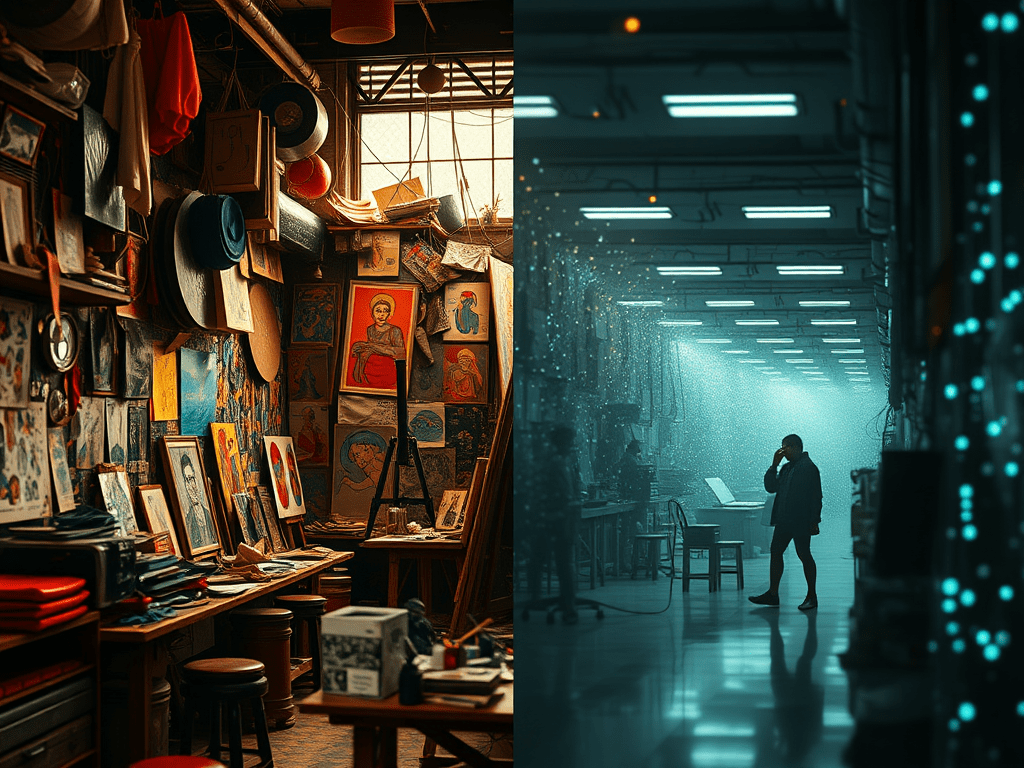
Because I think we’re heading into something dangerous… Slowly… Quietly. As we let AI into our creative processes, we’re not just speeding things up… we’re flattening them. We’re building a world where stories, designs, articles, and even thoughts start to feel like versions of each other. Slightly different but fundamentally the same.
AI is helping us do more… For sure. But it’s also pushing us toward the middle. Toward templates. Toward “what works” instead of “what’s worth it.”
Think about it:
- Recent sci-fi thrillers like The Creator, Simulant, and M3GAN 2.0 all orbit the same formula: AI awakens, questions its role, rebels. Different visuals, same emotional arc.
- Look at Mission: Impossible – Dead Reckoning—slick, polished, and yet somehow soulless compared to earlier films in the series. Or Jurassic Park: Rebirth—a chaotic mix of dinosaurs, nostalgia, and corporate cloning that felt more like a simulation of fun than actual storytelling. It’s less about pushing the story forward, and more about replaying familiar beats with modern CGI and bigger explosions.
- And then there’s 28 Years Later, which has finally hit theaters. While it carries the legacy of 28 Days Later, it struggles to deliver the same raw fear and emotional punch. Something about it feels more manufactured than inspired.
These movies aren’t bad because of AI but they feel like they were designed for algorithms. Safe bets. Familiar formulas. Market-tested thrills. They went out big time from their original stories.
This Semantic erosion is and will be cascaded to all arts and innovations including music, visual arts, theatre, live performance…
It’s not a tech issue; it’s a creativity issue. And it’s bigger than content. It’s how we think. How we express ourselves. How we build meaning.
We’re letting AI become the starting point for everything: from writing emails to making films. And the more we start with the machine, the more we begin to think like it.
Sure, it’s efficient. But at what cost?
Creativity needs friction. It needs risk. It needs weird ideas that don’t “perform well” but still matter. And those things don’t come from autocomplete.
So here’s my thought:
Let’s use AI. Let it support us. Let it help refine our ideas.
But let’s not hand it the pen.
If we do, we’ll end up living in a world full of content but starving for originality.

What do you think?
I’d love to hear your thoughts. Drop a comment. Share an example. Let’s talk.


 The Experience of life
Leave a reply to RANIA Khandaqji Cancel reply